 Eingana
The first being we call Eingana. We call Eingana our
Mother.
Indigenous peoples... are the traditional guardians of the Law of Mother Earth, a code of conservation inspired by a universally held belief that the source of all life is the Earth, the Mother of all creation.
The people of the oldest continuing culture on the
earths face, the Australian natives, name Eingana the Mother as the
creator, maker of all water, land, animals, and kangaroos, This huge
snake-goddess still lives, they say, in the ocean, rising up
occasionally to create yet more life.
At first, Eingana vomited living beings from her mouth. Then,
dissatisfied with this method of birth, she swallowed them again.
The primordial snake had no vagina; as her offspring grew inside
her, the goddess swelled up. Eventually, tortured with the
pregnancy, Eingana began to roll around and around. The god
Barraiya saw her agony and speared her near the anus so that birth
could take place as all creatures now give birth. From Eingana
poured her reborn creatures, which were chased by a dingo and took
on their earthly forms as they flew, ran, or hopped away.
The birth mother to these aboriginal people is also the death mother.
They say Eingana holds a sinew of life attached to each of her
creatures; when she lets it go, that life stops. If she
herself should die, they say everything would cease to exist.
Another snake goddess of the Aborigines in Australia is Julunggul. She is called also Kungpipi, Kalwadi, and Her ritual name is Mumuna. She is a rainbow snake goddess capable of assuming male, neuter, or androgynous form as well. She is embodied in the pearls, crystals, the ocean, waterfalls, and the deep pools where She lives. She is eternally pregnant which is a parallel with Eingana. She is a goddess of initiation (a second birth to the Aborigines) and puberty. At initiation young boys were symbolically swallowed and regurgitated out as young men. In Her legend She came to Arnhem Land in Australia in Dreamtime from a sinking land. Another similarity with Eingana is seen with Her in the legend of the Wawalag Sisters who violated a taboo concerning menstrual blood near Her lair. For this She continually eats and vomits forth the Sisters in Dreamtime.
|
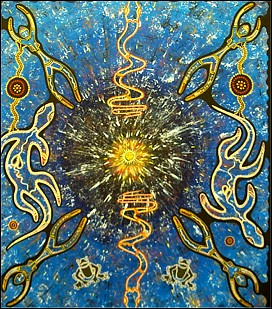
“Blue Spirit Creation”
|
 Activities
to do:
Activities
to do:
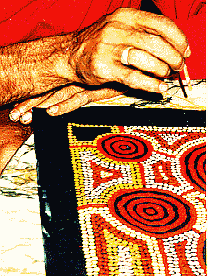
Aboriginal dream art
During your art and craft sessions
encourage the children to use traditional Aboriginal designs in
their work. Here are just a few ideas for you to use:
Badge making - Aboriginal flag, animal designs etc.
Beads/Necklaces - use dried seeds, leaves
Boomerangs - use cardboard or plywood (use a jigsaw to cut out), students then put their own designs on them.
Collage - use items which are collected from the bush. Magazines maybe used to depict the Aboriginal lifestyles.
Puppets - Put on a puppet show, make puppets about Aboriginal creation stories (legends) told by one of the community elders.
Banner - use calico, have each child create a design on a set size of calico, once this has been completed, sew all the pieces together and hang where friends can view.
The rocks remain.
The Earth remains.
I die and put my bones in the cave or the Earth.
Soon, my bones will become the Earth.
Then will my spirit return to my land, my Mother.
(Gagudju People of Australia)
This page last updated: 03/01/2018